

# Testing Cell

from aviary.api import Aircraft, Mission
from aviary.subsystems.mass.gasp_based.fuel import BWBFuselageMass, FuselageMass, TankCapacity
from aviary.utils.doctape import get_variable_name, glue_variable

glue_variable(get_variable_name(BWBFuselageMass), md_code=True)
glue_variable(get_variable_name(FuselageMass), md_code=True)
glue_variable(get_variable_name(TankCapacity), md_code=True)

glue_variable(get_variable_name(Mission.TOTAL_FUEL_MASS), md_code=True)

glue_variable(get_variable_name(Aircraft.Fuel.MAX_CAPACITY_MASS), md_code=True)
/home/runner/work/Aviary/Aviary/.openmdao-pixi/.pixi/envs/py313/lib/python3.13/site-packages/openmdao/core/constants.py:16: OMDeprecationWarning:The INF_BOUND sentinel in OpenMDAO is deprecated. Infinite bounds should now be specified using None or +/-np.inf.
BWBFuselageMass
FuselageMass
TankCapacity
Mission.TOTAL_FUEL_MASS
Aircraft.Fuel.MAX_CAPACITY_MASS
Core Mass Subsystem#
The core mass subsystem is responsible for calculating the mass properties of the aircraft. This includes the empty weight, fuel weight, payload weight, and other mass properties.
Note
This section is under further development.
FLOPS Based Mass Subsystem#
FLOPS used a series of regressions and basic relations to estimate the weight of various transport aircraft components. The equations used are well-documented and freely available[1]. Aviary uses mass instead of weight, which is a subtle but important change to be aware of.
Fuel_Capacity#
The Fuel Capacity Group contains 4 subsystems:
Wing Fuel Capacity
Aviary assumes that the wing volume can be approximated as a rectangular based pyramid, and that the available volume for fuel is a user specified fraction of this theoretcial volume (Aircraft.Fuel.WING_FUEL_FRACTION). The derivation of Aviary’s theoretical volume calculation is included below:
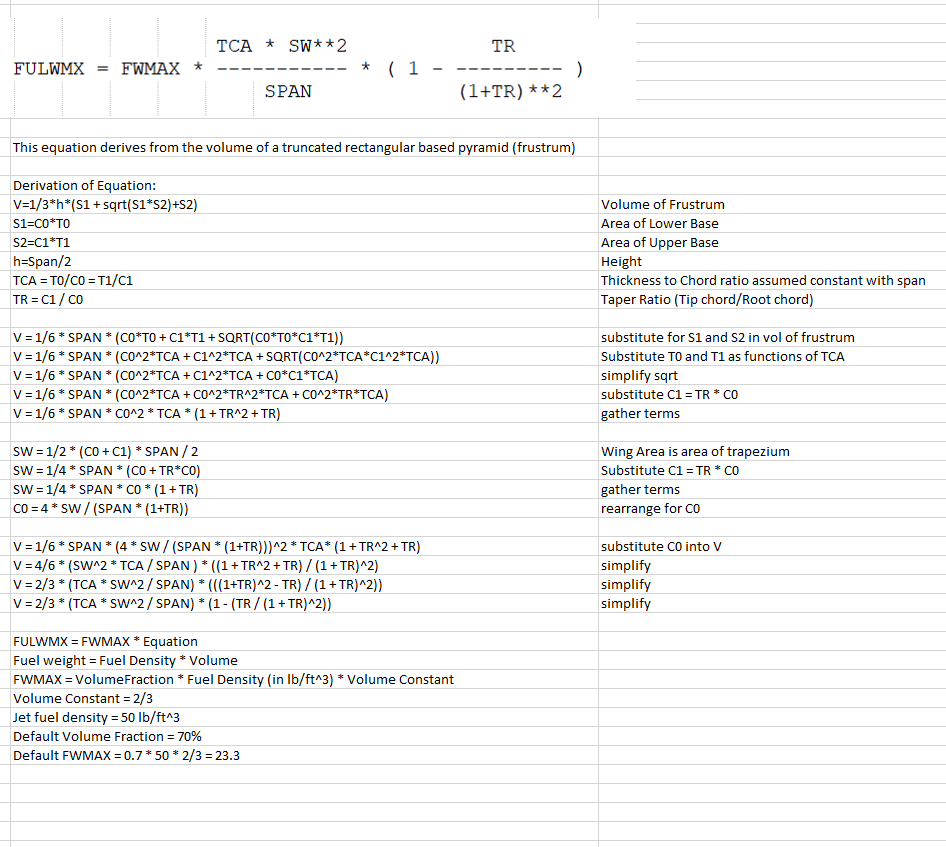
Aviary then converts the volume to a capacity (lbm) using the user specified fuel density (Aircraft.Fuel.DENSITY).
Fuselage Fuel Capacity
Fusleage Fuel Capacity = Total Fuel Capacity - Wing Fuel Capacity
Auxiliary Fuel capacity
Auxiliary Fuel Capacity = Total Fuel Capacity - Wing Fuel Capacity - Fuselage Fuel Capacity
Total Fuel Capacity
Total Fuel Capacity = Wing Fuel Capacity + Fuselage Fuel Capacity + Auxiliary Fuel Capacity
It is possible for Aviary to calculate negative fuel capacities depending on user overrides and the input wing geometry. These situations are not currently flagged to the user.
References#
For additional information, please see the following resources:
GASP Based Mass Subsystem#
Fuel Model#
The GASP mass subsystem has a nonlinear solver needed to compute fuel-related variables. In order for it to converge, one must provide good initial guesses for the inputs. Otherwise, it may claim that convergence is reached but gives rise to a strange solution.
The computation in the
TankCapacitycomponent can not be matched in GASP Fortran code exactly. It is possible thatextra_fuel_volumebecomes negative. We added code to make sure that it is always positive.Note: The historic name of
FUEL_MASS_REQUIREDisINGASP.WFAREQ, butWFAREQincludes fuel margin in GASP whileFUEL_MASS_REQUIREDdoesn’t. The historic name ofTOTAL_FUEL_MASSisINGASP.WFA, but does not include fuel margin in GASP.Note: GASP Fortran code has features that are not implemented in Aviary (e.g. tail boom support, tip tank weight, fuselage acoustic treatment, pylon, acoustic treatment).
The fuel computation is a nonlinear system of equations. A simplied XDSM diagram is shown below:
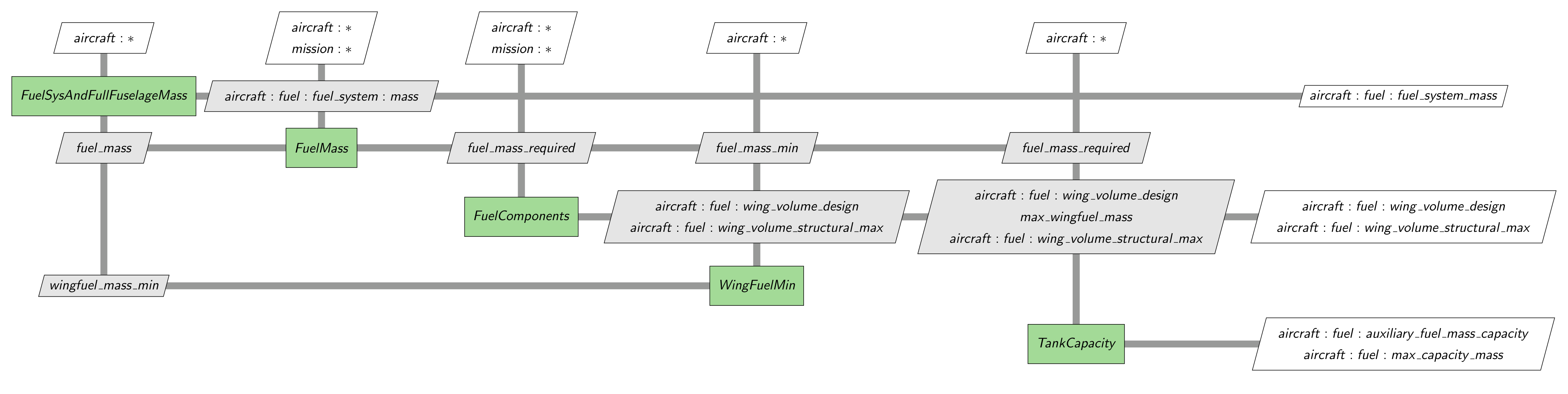
A Newton solver is applied until FUEL_MASS, wingfuel_mass_min and Aircraft.Fuel.MAX_CAPACITY_MASS are converged.
For conventional aircraft, BWBFuselageMass is replaced by FuselageMass.